
Data Analyst vs Data Scientist: What’s the Difference and Which Career Should You Choose?
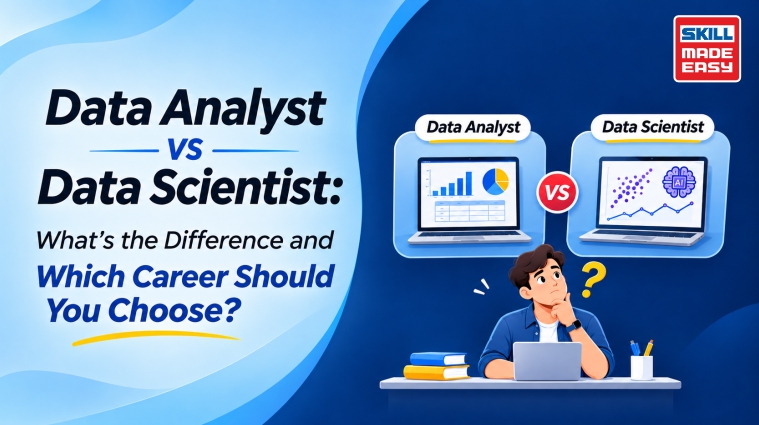
The data analyst vs data scientist comparison helps you understand two popular data careers. A data analyst uses tools like SQL, Excel, and Power BI to identify trends and generate business insights, while a data scientist uses Python, statistics, and machine learning to build predictive models.
When choosing between a data scientist vs data analyst, consider the required skills, job responsibilities, salary, and career growth. This guide explains the key differences, data analyst skills, data scientist skills, and data analyst vs data scientist salary in India to help you choose the right career.
Table of Contents
- 1. What Is the Difference Between a Data Analyst and a Data Scientist?
- 2. What Does a Data Analyst Do?
- 3. What Does a Data Scientist Do?
- 4. Data Analyst vs Data Scientist: Quick Comparison
- 5. What Skills Are Required for Each Role?
- 6. Data Analyst vs Data Scientist: Tools and Technologies
- 7. Data Analyst vs Data Scientist Salary in India
- 8. Which Career Is Better for Freshers?
- 9. How to Start a Career in Data Analytics or Data Science
- 10. Conclusion
- 11. Frequently Asked Questions
What Is the Difference Between a Data Analyst and a Data Scientist?
A data analyst focuses on understanding existing data and communicating insights, whereas a data scientist develops statistical and machine learning models to explain patterns, make predictions, and support automated decision-making.
The key difference is the type of problems they solve and the methods they use. Although their responsibilities can overlap, their primary objectives are often different.
For instance: An e-commerce company may hire a data analyst to understand which products generate the highest sales. A data scientist might develop a recommendation model that suggests products to individual customers.
What Does a Data Analyst Do?
A data analyst collects, cleans, examines, and interprets data to help businesses make informed decisions. The role focuses on identifying trends, monitoring performance, and presenting findings in a format that stakeholders can understand.
Here are the primary responsibilities of a data analyst:
- •Collect and clean data: Gather information from databases, spreadsheets, and other sources and correct inconsistencies.
- •Analyse trends: Identify patterns in sales, customer behaviour, website traffic, and business performance.
- •Create reports and dashboards: Use Excel, Power BI, or Tableau to present key performance indicators (KPIs).
- •Write SQL queries: Retrieve, filter, and aggregate data from databases.
- •Communicate insights: Explain findings to business teams and recommend practical improvements.
Example: A data analyst working for an online retailer might analyse customer purchases to identify popular products, compare monthly revenue, and understand why customers abandon their shopping carts.
The role is suitable for people who enjoy working with numbers, solving business problems, and communicating insights without necessarily developing complex machine learning models.
What Does a Data Scientist Do?
A data scientist uses programming, statistics, and machine learning to analyse complex datasets, discover patterns, and develop models that help organisations predict future outcomes.
The role often involves more experimentation and model development than traditional data analysis.
Typical responsibilities include:
- •Explore and prepare data: Process structured and unstructured datasets for analysis.
- •Apply statistical methods: Identify relationships, test hypotheses, and evaluate patterns.
- •Build predictive models: Use machine learning algorithms for forecasting, classification, and recommendation systems.
- •Evaluate model performance: Test accuracy, identify limitations, and improve model reliability.
- •Communicate results: Explain predictions and model outputs to technical and business teams.
Example: A data scientist at a bank might develop a model to estimate the likelihood of a loan default using customer income, repayment history, and other relevant information.
Data science is a good fit if you enjoy programming, mathematical problem-solving, experimentation, and building systems that learn from data.
Data Analyst vs Data Scientist: Quick Comparison
The following table summarises the major differences between these roles.
| Comparison Factor | Data Analyst | Data Scientist |
|---|---|---|
| Primary goal | Understand data and explain trends | Predict outcomes and develop models |
| Main focus | Reporting and business insights | Statistical modelling and machine learning |
| Programming | Basic to intermediate, depending on role | Usually intermediate to advanced |
| Mathematics | Statistics and descriptive analysis | Statistics, probability, and linear algebra |
| Common languages | SQL, Python, sometimes R | Python, SQL, sometimes R |
| Data handled | Often structured data | Structured and unstructured data |
| Common outputs | Reports, dashboards, recommendations | Predictive models, experiments, forecasts |
| Typical entry path | Analytics projects and reporting skills | Programming, statistics, and ML projects |
What Skills Are Required for Each Role?
The data analyst skills and data scientist skills overlap in several areas, but each career requires a different level of technical depth.
Data Analyst Skills
To become a data analyst, focus on these essential skills:
- •SQL: Query databases, filter records, join tables, and aggregate results.
- •Excel: Use formulas, pivot tables, charts, and lookup functions.
- •Data visualisation: Build dashboards and reports using Power BI or Tableau.
- •Basic statistics: Understand averages, distributions, correlation, and trends.
- •Python: Learn pandas and basic data analysis techniques to work with larger datasets.
- •Communication: Explain findings and present recommendations clearly.
You should also develop business understanding so you can connect data insights to measurable outcomes.
Data Scientist Skills
A data scientist needs a stronger foundation in programming, mathematics, and predictive modelling.
- •Python and SQL: Process datasets, manipulate data, and retrieve information.
- •Statistics and probability: Understand distributions, hypothesis testing, and uncertainty.
- •Mathematics: Learn linear algebra and calculus fundamentals relevant to machine learning.
- •Machine learning: Understand regression, classification, clustering, and model evaluation.
- •Data processing: Work with pandas, NumPy, and other relevant libraries.
- •Model deployment: Learn APIs, version control, and basic MLOps as you progress.
You do not need to master every advanced technique before applying for an entry-level role. Build a strong foundation first, then specialise according to your interests and target jobs.
Data Analyst vs Data Scientist: Tools and Technologies
Both professionals use tools to process data, identify patterns, and communicate findings. However, their toolsets differ according to their responsibilities.
| Tool or Technology | Data Analyst | Data Scientist |
|---|---|---|
| Excel | Data cleaning and reporting | Initial data exploration |
| SQL | Essential for data retrieval | Essential for data retrieval and preparation |
| Python | Data analysis and automation | Data analysis, modelling, and experimentation |
| Power BI / Tableau | Dashboards and business reporting | Visualisation and communicating model results |
| Pandas / NumPy | Data manipulation and analysis | Data processing and numerical computing |
| Scikit-learn | May be used for basic analytics models | Machine learning and model evaluation |
| TensorFlow / PyTorch | Usually not essential | Useful for deep learning and specialised applications |
| Git / GitHub | Version control and collaboration | Version control and collaboration |
Example: A data analyst may use SQL and Power BI to create a sales dashboard. A data scientist may use Python and Scikit-learn to build a model that forecasts future sales.
Start with the tools relevant to your chosen role instead of trying to learn every technology at once.
Data Analyst vs Data Scientist Salary in India
The data analyst vs data scientist salary comparison depends on experience, technical skills, location, industry, and company type. Data scientists can earn more in specialised roles involving machine learning and advanced modelling, but salaries vary considerably between employers.
The following are broad, indicative annual salary ranges in India, not guaranteed averages.
| Experience Level | Data Analyst | Data Scientist |
|---|---|---|
| Entry-level | ₹3–6 LPA | ₹4–8 LPA |
| Mid-level | ₹6–12 LPA | ₹8–20 LPA |
| Senior-level | ₹12–20+ LPA | ₹18–35+ LPA |
Note: LPA means lakhs per annum. These figures are illustrative market ranges; actual compensation depends on the employer, role requirements, location, and salary data source.
Several factors influence your earning potential:
- •Experience: Professionals with strong project experience and a track record of delivering results may qualify for higher-paying positions.
- •Technical skills: Machine learning, cloud platforms, advanced SQL, and data engineering can help you qualify for specialised roles.
- •Location: Technology hubs such as Bengaluru, Hyderabad, Pune, and Gurugram offer opportunities across analytics and data science.
- •Company type: Product companies, multinational corporations, and specialised technology firms may offer competitive packages.
- •Business impact: Your ability to translate data into measurable business improvements can strengthen your career prospects.
For current salary estimates, compare recent listings on Indeed India and other salary platforms, checking the experience level and job title before drawing conclusions.
Which Career Is Better for Freshers?
For many beginners, data analytics can be a more accessible starting point because you can begin with SQL, Excel, visualisation, and basic statistics. Data science may be a better fit if you already enjoy programming, mathematics, and machine learning.
The answer to which is better: data scientist vs data analyst depends on your interests, current skills, and career goals.
Choose Data Analytics If You:
- •Prefer working with business data, reports, and dashboards.
- •Enjoy finding patterns and explaining why something happened.
- •Want to start with SQL, Excel, and visualisation tools.
- •Prefer a practical entry route that does not initially require advanced machine learning.
Choose Data Science If You:
- •Enjoy programming and mathematical problem-solving.
- •Want to build predictive models and machine learning applications.
- •Are willing to invest time in statistics, algorithms, and experimentation.
- •Want to explore specialised areas such as recommendation systems or predictive analytics.
Neither career guarantees a higher salary or faster employment. Your portfolio, communication skills, practical experience, and ability to solve real problems matter in both fields.
How to Start a Career in Data Analytics or Data Science
Follow these steps to build a foundation and prepare for entry-level opportunities.
- 1Step 1: Learn the fundamentals. Start with spreadsheets, basic statistics, and SQL. If you are interested in data science, add Python and mathematical foundations.
- 2Step 2: Choose your specialisation. For analytics, prioritise dashboards, reporting, and business problem-solving. For data science, continue with data processing, machine learning, and model evaluation.
- 3Step 3: Build practical projects. Create a sales dashboard, customer analysis report, or business performance study for analytics. For data science, build a price prediction model, customer churn classifier, or recommendation system.
- 4Step 4: Create a portfolio. Upload your projects to GitHub where appropriate. Explain the problem, dataset, methodology, results, and limitations instead of sharing code alone.
- 5Step 5: Prepare for interviews. Practise SQL queries, statistics, analytical case studies, and communication. Data science candidates should also prepare for Python coding and machine learning questions.
- 6Step 6: Apply for relevant roles. Search for junior data analyst, business intelligence analyst, associate data scientist, and other entry-level positions that match your skills.
You can also move from data analytics into data science over time by strengthening your Python, statistics, and machine learning knowledge. However, this transition requires deliberate practice rather than relying on job experience alone.
Conclusion
The data analyst vs data scientist comparison comes down to the kind of problems you want to solve. Data analysts use data to explain trends and guide business decisions, while data scientists develop models to predict outcomes and address complex problems.
If you prefer SQL, dashboards, and business insights, data analytics may be the right starting point. If you enjoy programming, mathematics, and machine learning, data science may suit you better. Both careers offer opportunities in India, and neither is automatically better for every candidate.
Choose the path that matches your strengths, build relevant projects, and develop practical skills before focusing on salary alone.
Frequently Asked Questions
1. Is a data scientist better than a data analyst?
Neither role is universally better. Data scientists focus more on predictive modelling and machine learning, while data analysts focus on reporting, trends, and business insights. Your interests and skills should guide your choice.
2. Can a data analyst become a data scientist?
Yes. A data analyst can transition into data science by learning Python, statistics, machine learning, and model evaluation, then building relevant projects to demonstrate these skills.
3. Which career pays more in India: data analyst or data scientist?
Data scientists may earn more in specialised machine learning and modelling roles, particularly with experience. However, salaries vary by employer, location, technical expertise, and job responsibilities.
4. Can freshers become data scientists without a master’s degree?
Yes. Some entry-level roles accept candidates with a relevant bachelor’s degree and strong practical skills. Requirements vary by employer, so review job descriptions and demonstrate your knowledge through projects, programming, and statistics.